Lambda
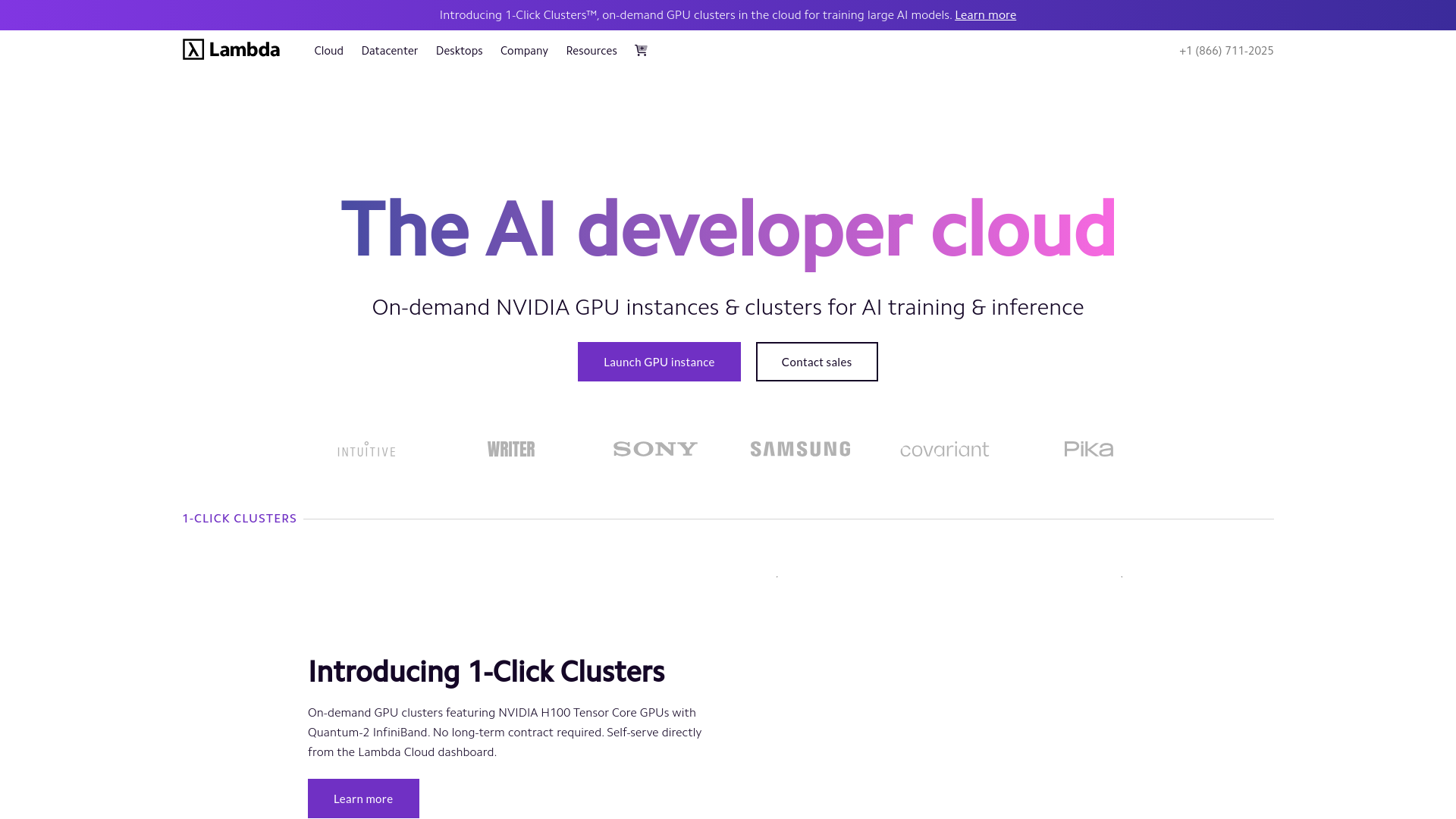
Deploy GPU clusters swiftly; extensive AI model training support.
About Lambda
Advertiser Disclosure: Futurepedia.io is committed to rigorous editorial standards to provide our users with accurate and helpful content. To keep our site free, we may receive compensation when you click some links on our site.
Key Features
- 1-Click Clusters: Allows users to deploy GPU clusters in the cloud swiftly and efficiently, which is ideal for projects requiring high computational power.
- Versatile Product Range: From cloud-based GPU instances to physical workstations like the Vector Pro GPU Workstation equipped with up to four NVIDIA GPUs.
- Cutting-edge Technology: Utilizes the latest NVIDIA GPUs, including the H100 and upcoming Blackwell GPUs, ensuring top-notch performance.
- Lambda Stack: Offers a one-line installation stack that includes PyTorch®, TensorFlow, CUDA, and more, simplifying the setup process for machine learning applications.
Pros
- Scalability: Easily scales resources to meet the demands of large-scale AI projects.
- Cost-Effective: Competitive pricing models, such as $2.49 per GPU hour for NVIDIA H100 instances, make it accessible for various users.
- Advanced Hardware: Provides some of the latest and most powerful GPUs available, ensuring efficient processing of complex computations.
- User-Friendly Interface: The Lambda Cloud dashboard is intuitive, making it easy for users to manage their resources.
Cons
- Geographic Availability: Services might be limited to certain regions, potentially increasing latency or affecting users in locations not fully supported.
- Complexity for Beginners: The high level of technical specification and options might overwhelm new users or smaller teams without dedicated IT support.
- Limited Free Resources: Compared to some competitors, there might be fewer free resources or trials, which could deter experimentation by startups or individuals.