Jupid
Handle bookkeeping, LLC setup, and taxes via chat.
About Jupid
Advertiser Disclosure: Futurepedia.io is committed to rigorous editorial standards to provide our users with accurate and helpful content. To keep our site free, we may receive compensation when you click some links on our site.
Key Features
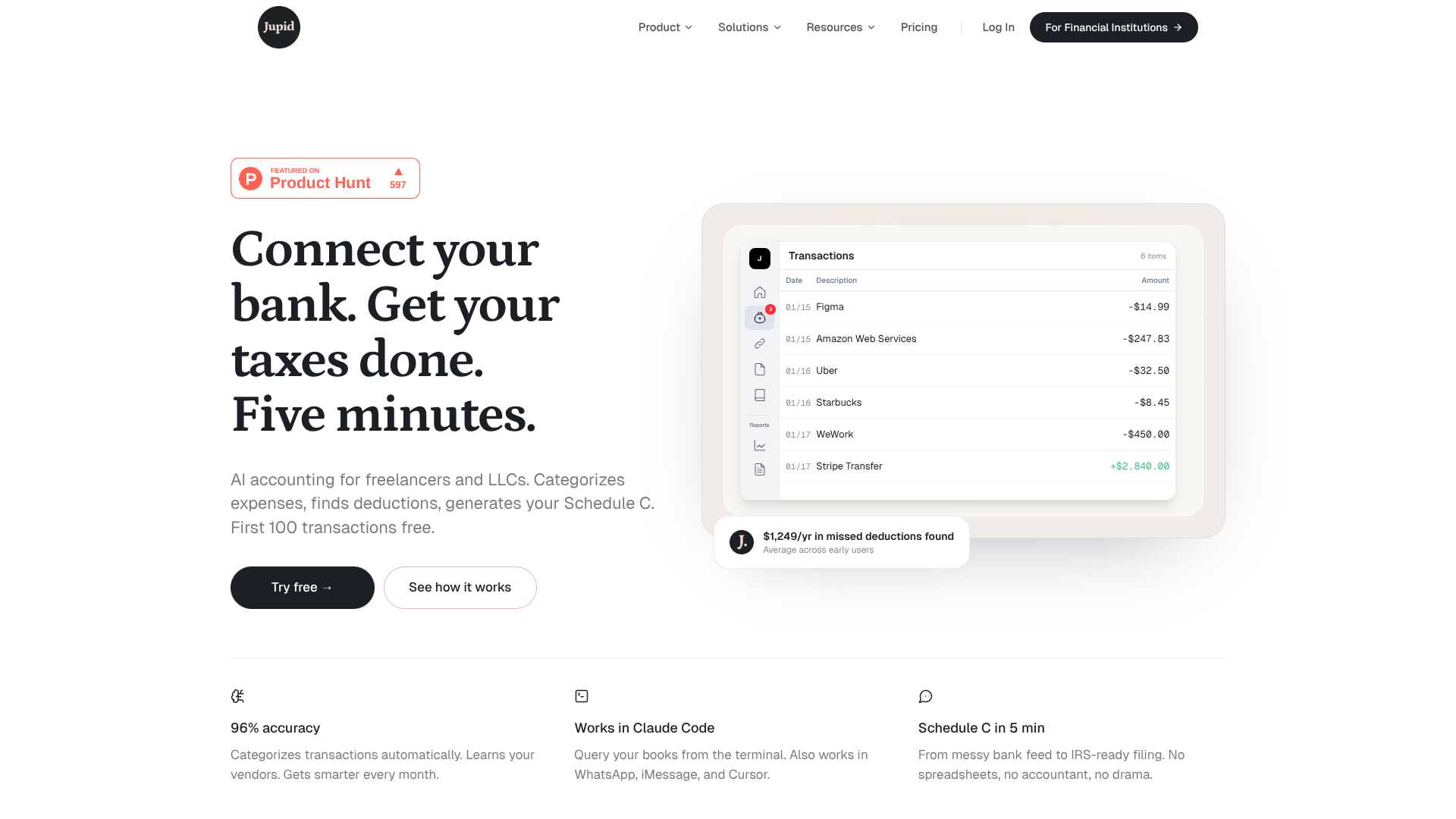
- AI Transaction Categorization: Automatically classifies expenses and income with around 96% accuracy, learns vendors over time, and maps every category directly to IRS Schedule C lines.
- Schedule C and Tax Workflow: Turns messy bank feeds into a ready-to-file Schedule C in minutes, with AI-prepared returns backed by human CPA review.
- Chat-First Accounting: Lets users categorize expenses, answer “is this deductible?” and supply missing context through WhatsApp, iMessage, or chat, without logging into a separate dashboard.
- Banking and App Integrations: Connects to US banks via Plaid plus platforms like Stripe and Deel, with optional CSV upload for those who are still bank-connection shy.
- MCP Server for Developers: Exposes books to tools like Claude Code and Cursor, so teams can query transactions and generate custom reports from the terminal or AI agents.
Pros
- True Persistent Memory: Keeps long-term financial context, preventing category drift that often appears when using generic chatbots for bookkeeping.
- End-to-End Coverage: Combines bookkeeping, LLC formation, and tax prep, reducing the need for multiple tools or add-ons.
- Mobile-Friendly Workflow: Quick “tap to confirm” interactions over messaging apps fit naturally into how solo operators already work.
- Accountant-Friendly Outputs: Produces clean, structured data and tax-ready reports that make life easier for existing CPAs and often reduce billable hours.
Cons
- US-Centric Focus: Strong emphasis on US banks and IRS Schedule C means limited value for non US businesses.
- AI Still Needs Oversight: Even high categorization accuracy requires periodic review, especially for edge cases and mixed personal or business spending.
- Less Suited to Complex Entities: Larger companies with multi-entity consolidations or niche GAAP workflows may find the feature set tilted toward simpler small business setups.